Case Study: How Arjun, a Travel Agent from Chandigarh, Makes Routine Work More Organized with Flyshop.in
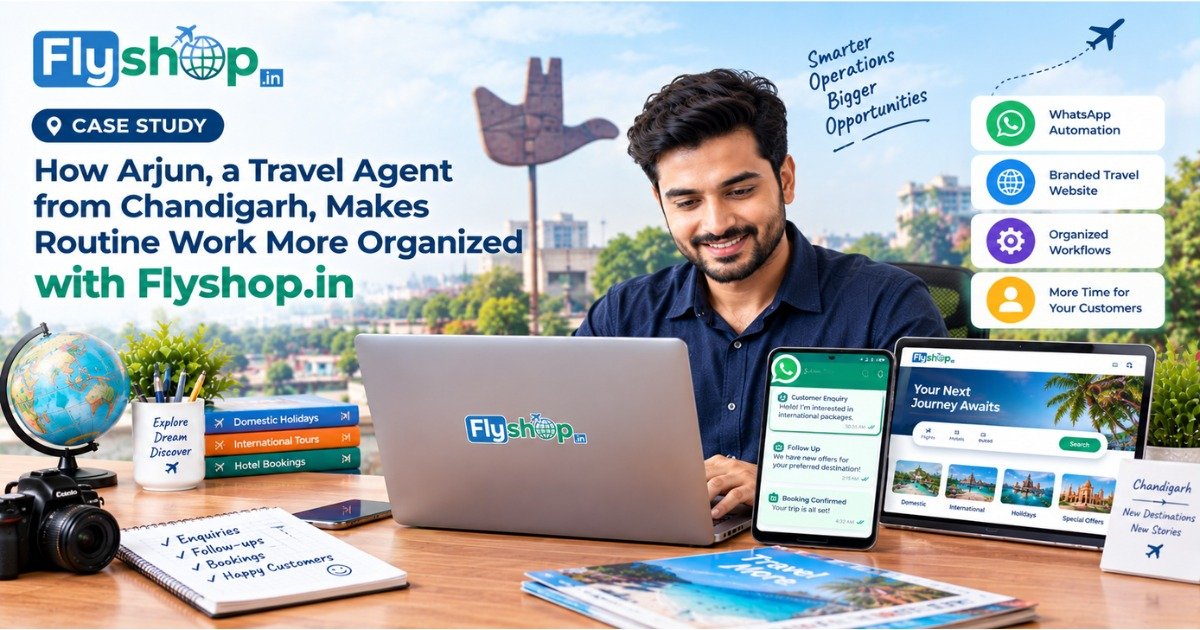
Meet Arjun, a Travel Agent from Chandigarh
Running a travel agency involves managing several activities at the same time. Travel agents answer customer questions, share package details, manage enquiries, provide booking information, and follow up with potential travellers. While these tasks are essential for customer service, handling every interaction manually can consume a significant amount of time.
Meet Arjun, a travel agent from Chandigarh who wants to make his daily operations more organized. As customer enquiries come in, he finds himself spending considerable time answering common questions and managing repetitive conversations.
One customer wants to understand the available travel options. Another asks how to proceed with a booking, while someone else needs basic information before deciding whether to enquire further. Although each conversation matters, many involve similar questions and routine communication.
Arjun realizes that he needs a better way to manage these activities without compromising the personal service his customers expect.
Instead of trying to automate every part of his business, he decides to identify repetitive tasks, explore suitable WhatsApp automation workflows, make better use of his branded Flyshop.in travel website, and reserve his attention for customers who need individual assistance.
His objective is straightforward: create a more organized workflow that supports both operational efficiency and a positive customer experience.
The Challenge: Too Much Time Spent on Repetitive Communication
Customer communication is an important part of running a travel business. Travellers often need information before they feel comfortable proceeding with an enquiry or booking.
However, not every interaction requires a completely new response.
For example, several customers may ask similar questions about travel services, available packages, enquiry procedures, or the next steps in the booking process. Arjun may also need to remind interested customers about information they requested or direct them to relevant details.
When these activities are managed entirely through manual conversations, they can become difficult to organize.
The challenge becomes more noticeable when multiple customers contact the agency at different times. Arjun must remember which conversations need attention, provide accurate information, and avoid overlooking enquiries while dealing with other responsibilities.
He identifies three areas where his workflow could improve:
- Repeated questions: Common queries require him to provide similar information multiple times.
- Time-consuming follow-ups: Keeping track of ongoing conversations can make his daily workload harder to manage.
- Limited time for individual assistance: Routine communication can take attention away from customers with complex travel requirements.
Arjun understands that the solution is not to eliminate customer conversations. Instead, he wants to reduce unnecessary repetition and organize the way routine interactions are handled.
Step 1: Identify Repetitive Tasks in the Daily Workflow
Before exploring automation, Arjun reviews the activities that take up time throughout his working day.
He starts by identifying the questions customers ask most frequently and the communication tasks he repeats regularly.
These may include providing basic information about travel services, directing customers to relevant website pages, explaining how to submit an enquiry, or following up with people who have requested additional details.
Arjun separates these activities from conversations that require personal attention.
For instance, sharing standard information about the enquiry process may be suitable for a prepared response. However, helping a family compare different holiday options may require a detailed discussion about budget, travel dates, destination preferences, and group requirements.
This distinction helps Arjun understand where a more structured process could be useful.
He also reviews whether the information he shares is clear, accurate, and easy for customers to understand. If customers repeatedly ask the same question because the available information is confusing, improving the information itself may be just as important as introducing automation.
By identifying the most repetitive activities first, Arjun creates a practical starting point for improving his workflow.
The key lesson: Do not automate tasks simply because they happen frequently. First, understand why they are repetitive and decide whether a clearer process could make them easier to manage.
Step 2: Explore WhatsApp Automation for Routine Communication
Once Arjun has identified suitable tasks, he explores how WhatsApp automation could support his customer communication process.
WhatsApp is an important communication channel for many businesses because it allows customers to ask questions and discuss their requirements directly. However, managing every routine interaction manually can become challenging as conversations increase.
Depending on the platform, configuration, and available features, WhatsApp automation can support predefined responses, guided conversation flows, and certain follow-up workflows.
Arjun considers how these capabilities might fit into his daily operations.
For example, a configured conversation flow could help customers find basic information about his travel services or guide them towards the next step in submitting an enquiry. Prepared responses could help him communicate common information more consistently.
Where suitable follow-up features are available, he could also organize reminders or other permitted communication for customers who have expressed interest.
Arjun understands that automation requires thoughtful configuration. Responses should be relevant to the customer's question, and customers should have an appropriate way to request personal assistance when their needs fall outside a predefined workflow.
He also considers customer preferences and applicable messaging requirements before setting up automated communication.
Rather than introducing multiple workflows at once, Arjun starts by focusing on the tasks that are easiest to standardize and most useful to customers.
The key lesson: WhatsApp automation works best when it supports a clearly defined process. Start with a few appropriate routine tasks and refine the workflow based on actual customer interactions.
Step 3: Use His Branded Flyshop.in Portal to Guide Customers
Arjun also recognizes that not every customer question needs to be answered through a separate manual conversation.
His branded Flyshop.in website can serve as an important destination for customers who want to explore his travel business online.
Instead of repeatedly explaining where customers can find relevant information, Arjun can direct them to the appropriate pages and available booking options on his portal.
For example, a customer interested in exploring travel services may be directed to the relevant section of his website. Someone who is ready to enquire can be guided towards the appropriate enquiry or booking option available through his setup.
This gives customers another way to access information while helping Arjun organize the customer journey.
A branded travel portal can also provide a consistent online presence for the agency. Customers have a dedicated destination where they can learn more about the business and explore the available services.
However, Arjun understands that the website should complement personal communication rather than replace it. Customers may still need clarification about package details, availability, prices, or their specific travel requirements.
He therefore focuses on making the next step clear: customers should understand where to find information and how to contact him when they need assistance.
By connecting routine communication with his online portal, Arjun creates a more structured path from the initial enquiry to further exploration of his travel services.
The key lesson: Use your branded website to make useful information easier to access. A clear online destination can support customer communication and reduce avoidable repetition.
Step 4: Keep Personal Service at the Centre
Although Arjun wants to organize routine work, he knows that travel planning is rarely identical for every customer.
Some travellers have straightforward questions, while others need help comparing destinations, selecting suitable packages, understanding itinerary details, or discussing special requirements.
These situations often require personal attention and a better understanding of the customer's expectations.
Arjun therefore makes sure his workflow leaves room for individual assistance.
For example, if a customer is unsure which holiday package best suits their budget, he can discuss the available options and explain the relevant differences. If someone has a complex itinerary or a specific request, Arjun can review the situation rather than relying on a standard automated response.
He also remains available when customers need clarification after visiting his website or interacting with a configured workflow.
This approach helps him balance efficiency with service quality. Routine tasks can follow an organized process, while conversations that require judgment, empathy, or detailed guidance remain personal.
Arjun recognizes that the purpose of automation is not to make the agency less accessible. It is to help him use his time more effectively so he can focus on interactions where his experience adds value.
The key lesson: Automation should support customer service, not remove the human connection that makes travel assistance valuable.
The Outcome: A More Organized Way to Manage Daily Work
By identifying repetitive activities, exploring WhatsApp automation, directing customers to his branded travel portal, and preserving personal assistance, Arjun develops a more structured approach to daily operations.
His process focuses on three practical priorities:
- More organized communication: Common questions and routine activities are easier to identify and manage.
- Clearer customer journeys: Customers can be directed towards relevant information and available booking options through his Flyshop.in portal.
- More focused personal service: Arjun can prioritize complex enquiries and customers who need individual guidance.
This creates a clearer framework for managing routine communication while keeping customer needs at the centre of his business.
The actual time saved and improvements in customer experience will depend on the workflows implemented, the quality of the information provided, and how effectively the process is maintained.
What Other Travel Agents Can Learn from Arjun
Arjun's journey offers five practical lessons for travel businesses that want to improve their daily operations.
1. Start with your biggest time-consuming tasks. Identify the questions and activities you repeat most often before choosing an automation solution.
Keep information clear and consistent. Well-organized information can reduce unnecessary back-and-forth communication.
Connect communication with your website. Direct customers to relevant information and available booking options whenever appropriate.
Automate selectively. Use configured workflows for suitable routine tasks rather than trying to automate every customer interaction.
Protect time for personal service. Make sure customers can receive individual assistance when their requirements need more attention.
Conclusion: Let Automation Support Your Travel Business
For a travel agent like Arjun, improving daily operations does not mean removing personal communication. It means organizing routine activities so that important customer interactions receive the attention they deserve.
By identifying repetitive tasks, exploring WhatsApp automation, making better use of his Flyshop.in portal, and keeping personal support available, Arjun creates a more organized approach to managing his travel business.
The bigger lesson is simple: technology can help travel agents streamline suitable routine work, but good service still depends on understanding customers and responding to their needs.
Want to explore automation options for your travel business with Flyshop.in?
Discover how a more organized approach to customer communication and your branded travel portal can support your daily workflow.
Reply AUTOMATION to learn more.


